ROASTED SQUASH, SAGE & HAZELNUT SOURDOUGH
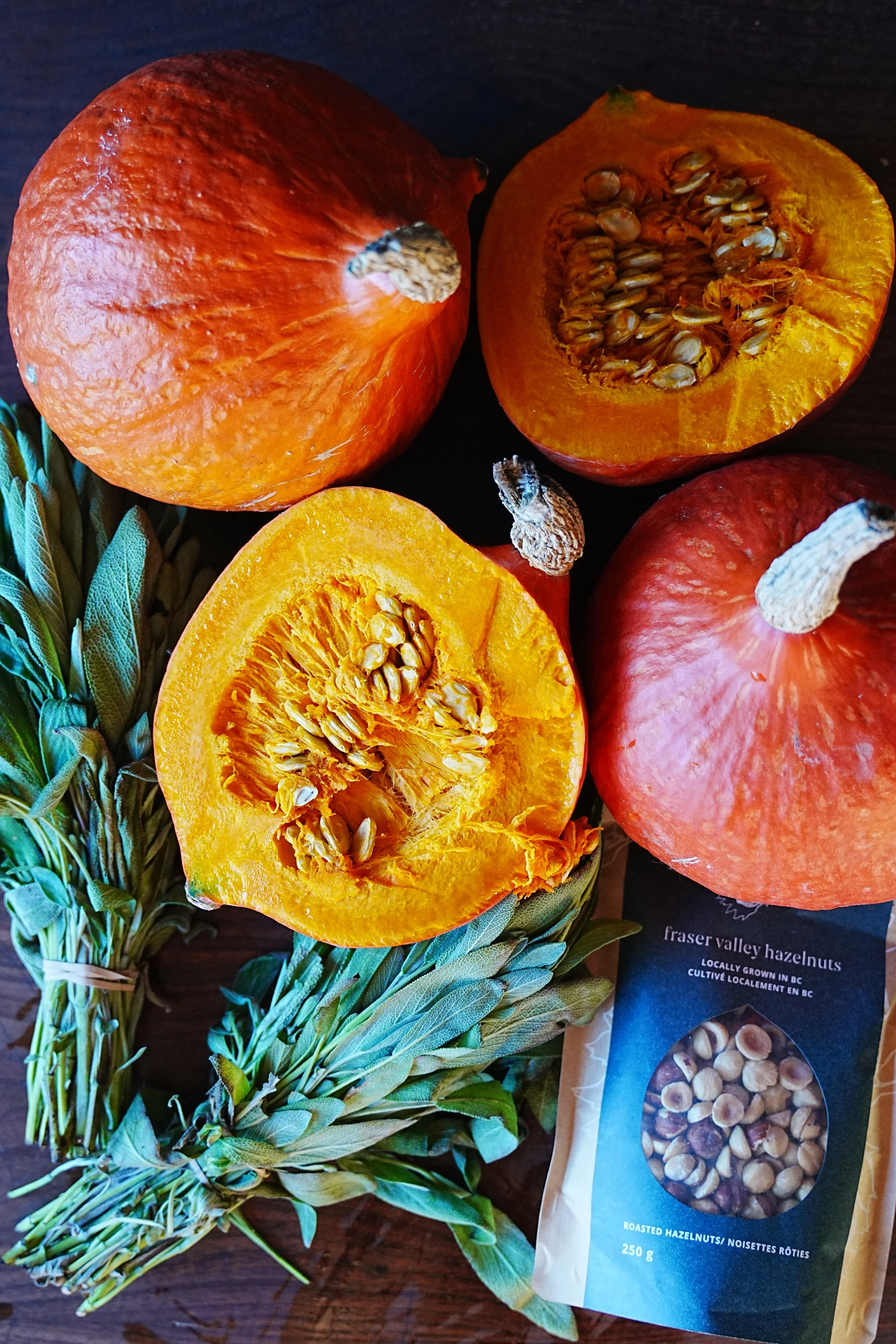
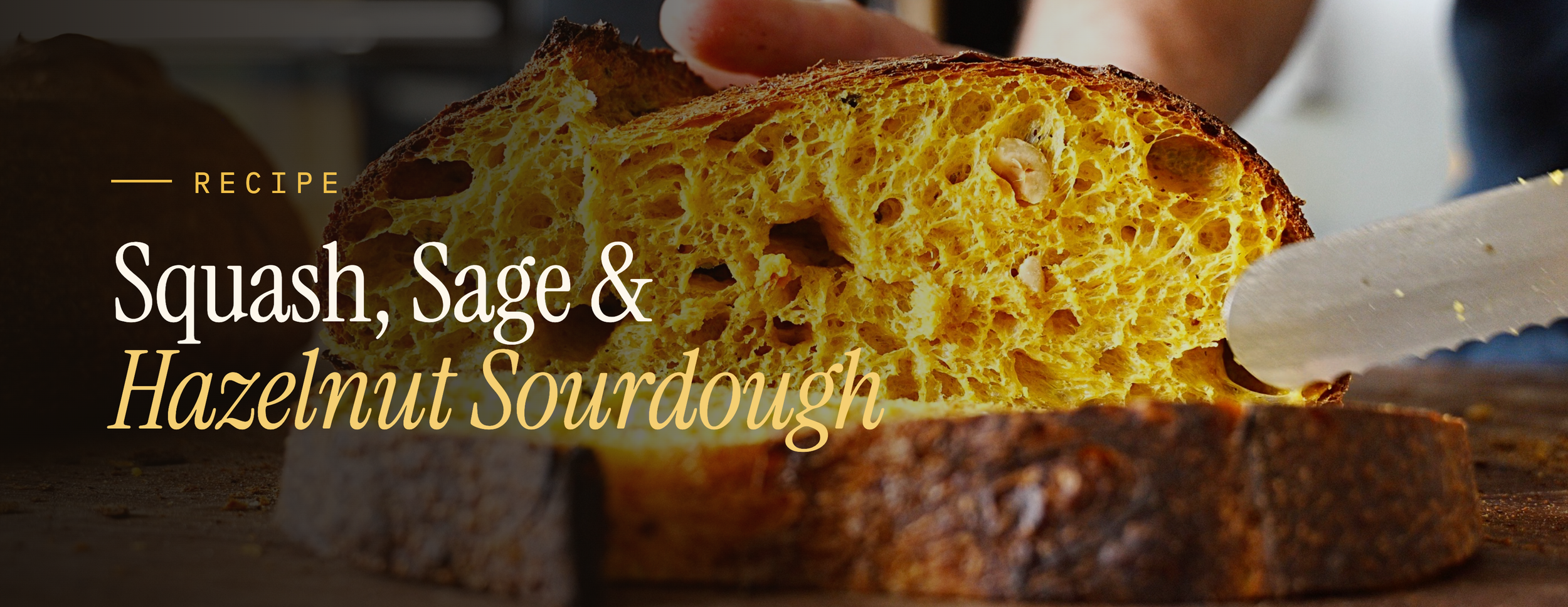
This loaf combines roasted red kuri squash, fresh sage, and toasted hazelnuts. The squash adds colour, moisture, and gentle sweetness without overwhelming the dough, while the hazelnuts and sage bring plenty of fall flavour.
Yield: Two loaves, 800 g each
Total dough: 1,600 g
Levain: 100% hydration
OVERALL FORMULA
Strong bread flour — 60%
Red Fife whole wheat flour — 30%
Water — 60%
Ripe levain — 20%
Fine sea salt — 2.2%
Seasoned roasted squash — 30%
Toasted hazelnuts — 14.9%
Fresh sage — 1%
Total — 218.1%
The flour and water contained in the levain bring the complete formula to 70% strong bread flour, 30% Red Fife flour, and 70% hydration.
LEVAIN
Active sourdough starter, 100% hydration — 6 g
Strong bread flour — 70 g
Water — 70 g
Total — 146 g
Mix the starter, flour, and water. Cover and ferment for approximately 12 hours at 21–22°C/70–72°F.
The levain should be well risen and aerated, with a gently domed surface and a pleasantly fermented aroma.
PREPARE THE SQUASH
1 small red kuri squash
Unsalted butter — 15 g
Brown sugar — 10 g
Fresh sage leaves — 4–6
Fine sea salt — a generous pinch
Heat the oven to 450°F/230°C.
Cut the squash in half and remove the seeds. Place it cut side up in a roasting pan. Divide the butter and brown sugar between the two halves, then add the sage leaves and salt.
Roast until completely tender and caramelized, basting the cut surfaces with the melted butter every 10 minutes. Depending on the size of the squash, this should take approximately 35–50 minutes.
Let the squash cool completely. Discard the whole sage leaves, scoop the flesh from the skin, and mash it with the buttery juices from the pan.
Weigh out 220 g for the dough. Extra roasted squash can be refrigerated for another use.
TOAST THE HAZELNUTS
Toast the hazelnuts at 350°F/175°C for 8–10 minutes, until fragrant.
Let them cool, rub off any loose skins, and chop them coarsely.
AUTOLYSE
Strong bread flour — 441 g
Red Fife whole wheat flour — 220 g
Water — 441 g
Total — 1,102 g
Combine the flours with all the water. Mix until no dry flour remains. Cover and rest for 30 minutes.
FINAL DOUGH
Autolyse — 1,102 g
Ripe levain — 146 g
Fine sea salt — 16 g
Seasoned roasted squash, completely cooled — 220 g
Toasted hazelnuts, coarsely chopped — 109 g
Fresh sage, finely chopped — 7 g
Total — 1,600 g
MIXING
Add the ripe levain and salt to the autolyse.
Mix for 5 minutes on medium-low speed. Increase to medium speed and mix for another 4–8 minutes, until the dough reaches full gluten development and passes the windowpane test.
Reduce the mixer to low speed. Add the cooled squash, toasted hazelnuts, and chopped sage. Continue mixing on low only until everything is evenly incorporated.
BULK FERMENTATION
Transfer the dough to a lightly oiled container.
Bulk ferment for approximately 4½–5 hours at 22°C/72°F.
Give the dough one fold after 45 minutes. If the dough still feels very loose and relaxed, give it a second fold after 90 minutes.
Bulk fermentation is complete when the dough feels aerated, has a slightly domed surface, and has increased noticeably in volume. Use the condition of the dough rather than the clock as your final guide.
DIVIDING AND SHAPING
Turn the dough onto a lightly floured work surface and divide it into two 800 g pieces.
Gently pre-shape each piece into a round. Cover and let rest for 20–30 minutes.
Shape the loaves into rounds or bâtards, then place them seam side up in well-floured proofing baskets.
FINAL PROOF
Leave the shaped loaves at room temperature for 1 hour.
After one hour, either bake the loaves immediately or cover and refrigerate them for 2–24 hours.
Bake refrigerated loaves directly from the refrigerator.
BAKING
Preheat the oven and two Dutch ovens to 475°F/245°C for at least 45 minutes.
Turn out and score the loaves. Bake covered for 20 minutes.
Remove the lids, reduce the oven temperature to 450°F/230°C, and continue baking for 25–30 minutes.
Bake these loaves dark. A deep crust brings out the roasted flavours and helps prevent the squash-enriched crumb from feeling overly moist. The centre of each loaf should reach approximately 208–210°F/98–99°C.
If you only have one Dutch oven, leave the second loaf refrigerated while the first one bakes.
Cool for at least three hours before slicing.
NOTES
Red kuri squash has a sweet, chestnut-like flavour, but kabocha or another dense winter squash can be substituted.
The squash contributes moisture beyond the stated 70% hydration. Using it at 30% of the flour weight gives the bread plenty of flavour while keeping the dough relatively easy to handle.